Click, Answer, Buy: How Quizzes, Video, and AI Are Reinventing the Product Page
Customer Engagement
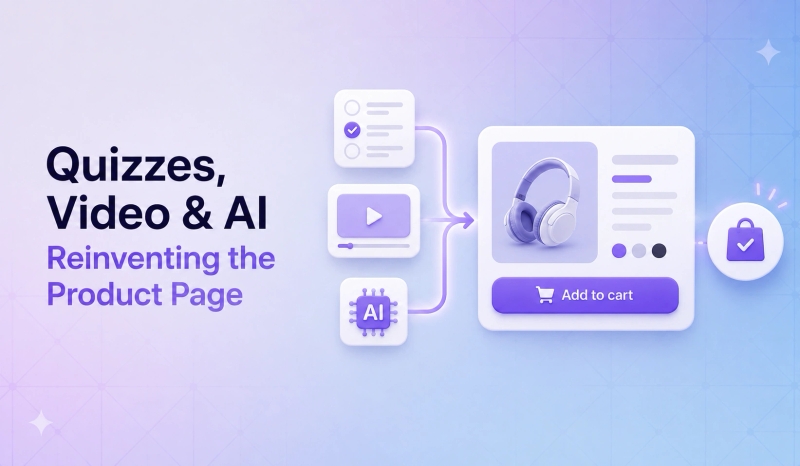
Static product pages, a photo, a description, a price—no longer cut it for today's online shoppers. Quizzes, product videos, and AI-powered personalization are replacing them with guided, interactive experiences that help shoppers decide faster and buy with more confidence. The brands building these interactive storefronts are converting more visitors and collecting better customer data along the way.
Walk into a well-run physical store and something almost invisible happens: a staff member reads your body language, asks a couple of questions, and walks you straight to what you actually need. You didn't browse 47 options. You didn't second-guess yourself. You just bought something that fit.
Now open a typical online store. You get a grid of product images, a description written for SEO, and a size chart nobody trusts. The gap between those two experiences is where billions of dollars in potential revenue quietly disappear each year.
The good news? That gap is closing. Quizzes, short-form video, and AI-driven personalization are giving online shoppers something they've never had before: a digital experience that actually guides them. The ecommerce platform you build on determines how well you can bring these tools together, and how quickly you can start seeing results. Wix supports long-term eCommerce growth with built-in loyalty programs, subscription commerce, back-in-stock notifications and flexible digital gift cards designed to increase customer lifetime value.
This post breaks down exactly how each of these tools works, why they outperform static pages, and how to start building an interactive storefront without overcomplicating things.
Why static product pages are losing the conversion battle
The average global ecommerce conversion rate sits between 2% and 3%, according to benchmark data from Dynamic Yield (2025). That means for every 100 people who land on a product page, 97 or more leave without buying. For most stores, the page itself is a big part of why.
Static product pages are built to present information, not to help someone make a decision. They assume the shopper already knows what they want, already understands the difference between the options, and just needs a place to confirm the purchase. That's rarely how shopping actually works.
Decision fatigue is real. When a shopper lands on a store selling 12 variations of the same moisturizer, they don't automatically know which one suits their skin type. They either spend too long reading, leave to watch a YouTube review, or—most commonly—just don't buy. A static page can't solve that. An interactive one can.
The brands pulling ahead on conversion aren't necessarily spending more on ads or launching more products. They're rethinking what happens after the click. Building on the right ecommerce platform gives you the flexibility to add quizzes, embed video, and connect AI tools, without having to rebuild your store from scratch every time you want to experiment.
Quizzes: the product recommender that sells while it segments
A product recommendation quiz does two things at once: it helps a shopper find the right product, and it tells you exactly who that shopper is. That combination is hard to beat.
Quiz marketing works because it turns a passive browsing session into an active conversation. Instead of asking someone to read through product specs and figure it out themselves, a quiz asks a few targeted questions—about goals, preferences, budget, lifestyle—and delivers a personalized recommendation at the end. The shopper gets clarity. You get a converted customer and structured data you can actually use.
The numbers behind quiz engagement are striking. According to Quizell, product recommendation quizzes generate opt-in rates of 40–60%, significantly higher than standard sign-up forms. That's because users feel they're getting something valuable in return—a result that's relevant to them, not just another promotional email.
Quizzes also reduce the friction that kills conversions. Decision paralysis—being overwhelmed by too many choices—is one of the most common reasons shoppers abandon product pages. A well-built quiz sidesteps that entirely by narrowing the options down to one or two genuinely relevant products. When a shopper feels guided rather than overwhelmed, they're far more likely to complete a purchase with confidence.
Different quiz formats serve different goals. A skincare brand might use a "find your routine" quiz. A fitness supplement brand might use a goal-based assessment. A gift shop during the holidays might build a gift finder that asks about the recipient, the budget, and the occasion. The format shifts, but the outcome stays the same: a shopper who arrived uncertain leaves with a recommendation they trust.
First-party data and the post-cookie opportunity
For years, ecommerce brands relied on third-party cookies to track user behavior, target ads, and personalize experiences. That infrastructure is increasingly unreliable. Safari and Firefox have blocked third-party cookies for years. Google paused its own deprecation timeline in April 2025, but the regulatory and browser-level pressure on cookie-based tracking continues to grow.
The brands that are already winning this transition didn't wait. They shifted to collecting customer data directly, through interactions on their own platforms, rather than by tracking users across the web.
This is the difference between first-party data (information collected from your own site, like purchases and email engagement) and zero-party data (information a customer intentionally shares with you, like quiz answers and stated preferences). Zero-party data is more accurate, more compliant, and more actionable than anything a tracking pixel could infer.
Quizzes are the most efficient tool for collecting zero-party data at scale. Every answer a shopper gives is an explicit, intent-driven signal. They're not clicking around hoping you'll notice—they're telling you directly what they need, what they can spend, and what problems they're trying to solve. That data can feed into your email segmentation, ad targeting, product development, and inventory planning.
The brands that treat their interactive content as a data collection engine—not just a conversion tool, are the ones building durable competitive advantages. The quiz isn't just a nice UX feature. It's how you get to know your customers without relying on technology you no longer control.
Video and AI: the two forces reshaping how products are experienced online
Product video: the closest thing to holding the item
Shoppers want to see products in motion, in context, in real life. According to research cited by Elkfox, viewers retain 95% of what they see in a video, compared to just 10% of what they read in text. That alone should change how you think about product descriptions.
The conversion data is even harder to ignore: StacksandStacks found that visitors are 144% more likely to purchase after watching a product video. Invodo's 2015 benchmarks showed shoppers who watch a product video are 1.7 times more likely to convert. And according to research aggregated by Elkfox, 96% of shoppers say they rely on product videos when making a buying decision.
Video works because it answers the questions a description can't. How does this jacket actually fit? Does this blender really handle frozen fruit that well? What does this sofa look like in a real living room? A short, honest product video answers those questions in 30 seconds and removes the uncertainty that causes cart abandonment.
You don't need a production budget to make this work. The most effective product videos are often the simplest—someone showing the product, demonstrating how it works, and calling out the details a shopper actually cares about.
AI personalization: recommendations that get smarter over time
AI adds another layer on top of static and interactive content: it adapts. Where a quiz delivers a personalized recommendation at one moment in time, AI continues to refine what it shows a shopper based on everything it learns about their behavior, preferences, and purchase history.
According to data from Anchor Group (2025), companies using AI personalization generate 40% more revenue than those that don't. AI-powered chat tools increase conversion rates by 4X and help shoppers complete purchases 47% faster. These are gains that compound—the more data the system has, the more accurate its recommendations become.
For interactive content marketing to reach its full potential, AI is the connective tissue. It takes the zero-party data collected through quizzes, the behavioral signals from video engagement, and the purchase history from your store, and turns all of it into a continuously improving personalization engine.
According to Forbes (2024), interactive content generates 52.6% higher engagement rates than static content. Pair that engagement with AI-driven recommendations, and you have a product page that doesn't just display a product—it actively helps someone decide to buy it.
Common mistakes that make interactive content backfire
Adding interactive elements to a product page doesn't automatically improve conversions. Done poorly, these tools can frustrate shoppers and hurt performance more than a clean static page would.
Making quizzes too long. A quiz that takes more than two minutes to complete will see sharp drop-offs in completion rates. Keep it under seven or eight questions. If you can answer the shopper's core question in four, do it in four.
Not acting on the data you collect. Gathering zero-party data through a quiz and then doing nothing with it is one of the most common and costly mistakes in interactive content. If a shopper tells you their skin is dry and sensitive, and your next email sends them a promotion for an exfoliating acid, you've broken trust.
Adding video without optimizing for page speed. Unoptimized video files are one of the fastest ways to tank your page load time—and your SEO. Use compressed, hosted video (YouTube, Vimeo, or a dedicated video hosting tool) rather than uploading raw files directly to your product page.
Weak results pages. A quiz with a strong experience but a vague results page converts nobody. The results page is the moment of highest intent—it needs a clear product recommendation, a specific reason why it's the right fit, and a direct path to purchase.
Using AI without enough training data. AI personalization tools need data to be useful. Launching an AI recommendation engine on a store with limited purchase history or product catalog depth often produces generic results that undermine trust rather than build it.
Building your interactive storefront: where to start
The most common mistake is trying to do everything at once. Pick one area, test it properly, and build from there.
- Start with a product recommendation quiz on your highest-traffic category page. Choose the product line where shoppers most often ask "which one is right for me?" and build a quiz around that question. Track completion rates, opt-in rates, and post-quiz conversion rates separately from your baseline.
- Add video to your top three to five product pages before rolling it out broadly. Identify the products with the highest traffic but below-average conversion rates—those are typically your biggest opportunity. A short demo or lifestyle video on those specific pages will give you clean data on the impact before you invest in video production at scale.
- Build a first-party data strategy before you connect AI tools. Map out what data you're collecting, where it lives, and how it flows into your email and ad platforms. AI personalization is only as good as the data feeding it. Getting your data infrastructure right first means any AI tools you add later will work much better from day one.
- Choose an ecommerce platform that supports these integrations natively or through its app ecosystem. Stitching together incompatible tools creates maintenance headaches and data silos. The right platform makes it easier to connect quizzes, video, and AI into a single coherent experience rather than a patchwork of features that don't talk to each other.
The product page of the future is already here
Static product pages aren't disappearing overnight—but their role is shrinking. Shoppers have more options, more distractions, and less patience than ever. The brands that understand this aren't just adding new features to their pages. They're rethinking what a product page is supposed to do.
A product page that guides, personalizes, and builds confidence doesn't just convert better today. It collects the data and earns the trust that makes every future marketing effort more effective. The tools to build that page exist right now. The brands using them are already pulling ahead.