How AI Is Changing Product Recommendations in Ecommerce
Marketing & Growth
Product recommendations are at the core of ecommerce.
But the way they work is changing fast.
In the past, recommendations were:
- Static
- Rule-based
- Generic
Today, they are:
- Dynamic
- Personalized
- AI-driven
Artificial intelligence is transforming how brands understand customers and suggest products—and it's quickly becoming a competitive advantage.
In this guide, you'll learn:
- What AI product recommendations are
- How they work
- How they compare to traditional methods
- How quizzes and AI work together
- How to implement AI-driven recommendations in your store
What Are AI Product Recommendations?
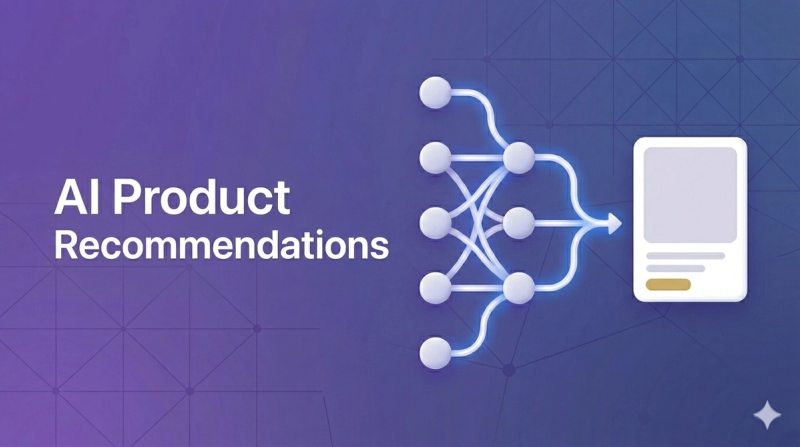
AI product recommendations use machine learning and data to automatically suggest the most relevant products to each individual user.
Instead of showing the same products to everyone, AI allows you to show different products to different users—based on their behavior, preferences, and intent.
These recommendations can appear on:
- Product pages
- Homepages
- Emails
- Checkout flows
Why AI Product Recommendations Matter
Modern ecommerce faces a key challenge: too many products, not enough guidance.
AI solves this by:
- Filtering options
- Predicting preferences
- Delivering relevance
Benefits of AI Recommendations
- Higher conversion rates
- Increased average order value
- Better user experience
- More efficient product discovery
How AI Product Recommendations Work
AI recommendation systems typically follow three core steps.
1. Data Collection
AI systems rely on data such as:
- Browsing behavior
- Purchase history
- Click patterns
- User inputs
2. Pattern Recognition
Machine learning models analyze:
- Similar users
- Product relationships
- Behavioral trends
3. Prediction
Based on this data, AI predicts what the user is most likely to want and surfaces those products.
Types of AI Recommendation Systems
Collaborative Filtering
- Based on what similar users bought
- Powers features like "Customers also bought"
Content-Based Filtering
- Based on product attributes
- Matches similar items
Hybrid Systems
- Combine multiple approaches
- More accurate and flexible
AI vs Traditional Product Recommendations
Traditional Recommendations
- Rule-based
- Static
- Generic
Examples: best sellers, featured products.
AI Recommendations
- Dynamic
- Personalized
- Data-driven
Key Difference
Traditional recommendations are the same for everyone. AI recommendations are unique for each user.
The Limitations of AI Alone
AI is powerful—but it has limitations.
1. It Relies on Past Behavior
AI often uses clicks and purchases. But this reflects what users did, not what they want now.
2. It Struggles with New Users
No data = no predictions.
3. It Can Be Inaccurate
Behavior can be misleading.
Example: a user browsing gifts may not want those products for themselves.
The Rise of Zero-Party Data
To solve these limitations, brands are turning to zero-party data.
This is data users intentionally share.
Examples:
- Preferences
- Goals
- Needs
AI + Quizzes: The Most Powerful Combination
AI becomes significantly more effective when combined with quizzes.
Why This Works
Quizzes provide:
- Explicit user input
- Structured data
- Real-time intent
AI enhances this by:
- Processing responses
- Improving recommendations
- Optimizing outcomes
Example Flow
- User answers quiz questions
- Data is captured (zero-party data)
- AI analyzes patterns
- Personalized recommendation is delivered
How AI Improves Quiz Performance
AI enhances quizzes in several ways.
1. Better Recommendations
AI refines product matching beyond simple logic.
2. Smarter Segmentation
AI identifies deeper patterns across users.
3. Continuous Optimization
AI improves results over time based on data.
4. Predictive Personalization
AI anticipates what users want next.
AI and Ecommerce Personalization
AI is a key driver of personalization.
It enables:
- Dynamic recommendations
- Adaptive content
- Predictive experiences
AI vs Quiz-Based Personalization
AI-Only Personalization
- Based on behavior
- Passive
- Less accurate for new users
Quiz-Based Personalization
- Based on direct input
- Explicit
- Highly accurate
Best Approach
Combine both: AI + quizzes.
AI in Quiz Funnels
AI enhances quiz funnels by:
- Improving segmentation
- Optimizing flows
- Increasing conversion rates
AI and Interactive Content
AI makes interactive content more powerful by:
- Personalizing outcomes
- Improving engagement
- Automating optimization
Real-World Use Cases
Skincare Brand
AI + quiz: analyze skin concerns, recommend routine.
Supplement Brand
AI + quiz: understand goals, suggest stack.
Ecommerce Store
AI tracks behavior. Quiz captures intent. Combined: highly accurate recommendations.
How to Implement AI Product Recommendations
Step 1 — Choose Your Data Sources
Use:
- Behavioral data
- Quiz data
Step 2 — Define Your Recommendation Logic
Combine:
- Rules
- AI models
Step 3 — Use Quizzes for Input
Capture:
- Preferences
- Needs
- Intent
Step 4 — Apply AI Optimization
Improve:
- Matching
- Segmentation
- Results
Step 5 — Test and Refine
Track:
- Conversion rate
- Engagement
- Revenue
Common Mistakes to Avoid
Relying Only on AI
This misses user intent.
Ignoring Zero-Party Data
This reduces accuracy.
Overcomplicating Systems
This slows implementation.
Not Testing Results
This limits improvement.
Best Practices
- Combine AI with quizzes
- Focus on user intent
- Keep experiences simple
- Continuously optimize
AI and the Future of Ecommerce
AI is becoming central to:
- Product discovery
- Personalization
- Customer experience
But the winners will be those who combine AI with direct user input.
What Happens When You Use AI Recommendations
You will:
- Increase conversions
- Improve accuracy
- Deliver better experiences
- Scale personalization
Conclusion
AI is transforming ecommerce—but it's not enough on its own.
The most effective strategy is: AI + quizzes + zero-party data.
This combination allows you to:
- Understand users
- Personalize experiences
- Drive conversions
Ready to Use AI for Product Recommendations?
With Quizell, you can:
- Combine AI and quizzes
- Capture zero-party data
- Deliver personalized recommendations
- Optimize performance
Start using AI-powered recommendations to improve your ecommerce results.